
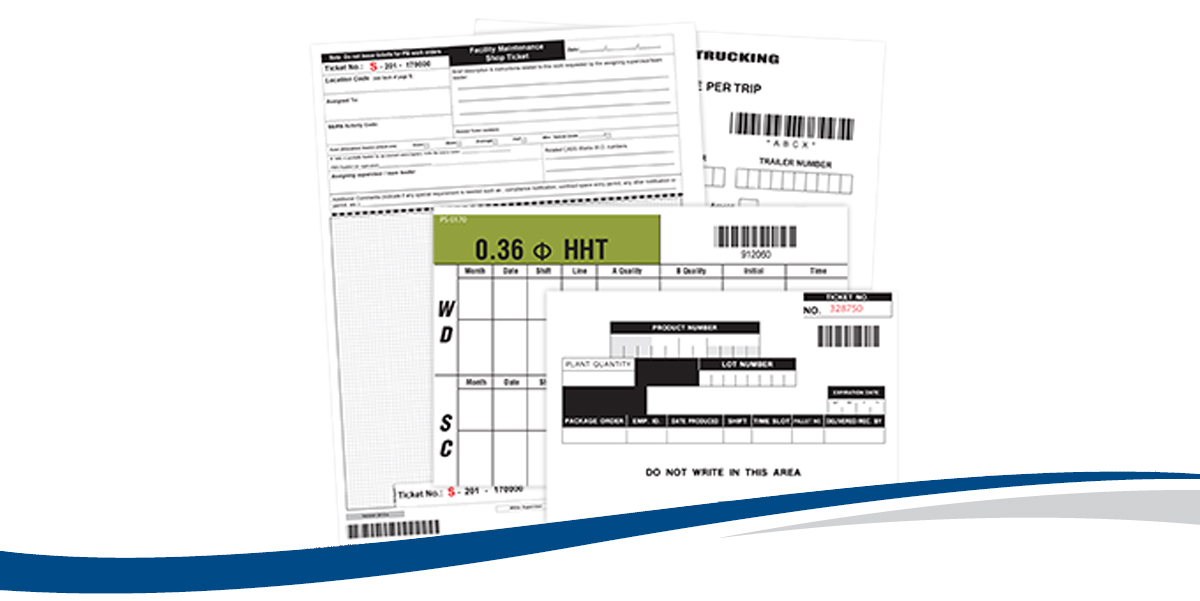
At Wise, we use the latest in barcoding technology to ensure the highest quality and accuracy in variable image printing. With our high-quality, versatile high-speed digital imaging systems, we produce crisp, clear barcodes for a wide variety of applications on forms and other documents, including cut sheet, unit set, and continuous products. Barcodes can be serialized or non-serialized, depending on your application.
Wise has the barcode solutions to help you become a leader in all of the vertical markets you serve. With our team of printing experts, you’ll get the right product, at the right price, when you need it.
APPLICATIONS
- Service/repair forms
- Mailing documents
- Patient identification
- Bills of lading
- Inventory control forms
- Statements
- Applications
- Purchase orders
- Inventory tags
- Coupons
Barcode Types
A UPC (Universal Product Code) barcode is a machine-readable barcode that consists of a series of vertical lines and spaces of varying widths that represent a unique 12-digit number. UPC barcodes are used to identify and track products in the retail industry and are commonly found on product packaging. When scanned, these barcodes can be used to retrieve product information, such as the item name, price, and inventory levels. Virtually all products sold in North America use either the UPC-A barcode or its shortened version, the UPC-E barcode, in situations where space is limited.
The PostNet (Postal Numeric Encoding Technique) barcode is used by the United States Postal Service to encode ZIP Code information for efficient mail sorting and delivery. It consists of a series of vertical bars of varying lengths that represent the ZIP Code digits and delivery point information. When scanned, the barcode allows for accurate and automated mail sorting, reducing errors and improving delivery times.
A 2 of 5 barcode uses two wide bars and three narrow bars to represent each digit. The barcode is typically used for inventory tracking and is capable of encoding a limited amount of information, usually up to 12 digits. The 2 of 5 barcode is a simple, reliable format that can be easily read by low-cost barcode scanners, making it a cost-effective solution for applications that do not require high levels of data density or security. While simple and reliable, 2 of 5 barcodes are less commonly used today due to their low data density compared to newer barcode formats. They are, however, still used for applications such as labeling packages or pallets with a limited number of digits for tracking purposes.
Code 39 barcodes can encode alphanumeric characters using a combination of nine bars and spaces of varying widths. Code 39 is one of the most commonly used barcode formats and is widely used in industries such as automotive, healthcare, and logistics. These barcodes can encode up to 43 characters, including letters, numbers, and some special characters, making them a versatile option for product identification and tracking. Code 39 barcodes are easy to read and can be printed in a variety of sizes, making them a popular choice for a range of applications.
Code 93 is a more robust version of the Code 39 barcode. Like the Code 39 barcode, it uses a combination of bars and spaces to encode data but is capable of encoding more characters per unit of space. Code 93 barcodes can encode up to 47 characters, including letters, numbers, and some special characters, and are commonly used in areas such as inventory and logistics. Code 93 barcode are similar in appearance to Code 39 barcodes but include an additional checksum character for increased data accuracy and security.
An EAN (European Article Number) barcode is used to identify and track products in the retail industry worldwide. It consists of a 13-digit number that uniquely identifies a product, encoded as a series of bars and spaces of varying widths. EAN barcodes are commonly found on product packaging and can be scanned at the point of sale to retrieve product information, such as the item name, price, and inventory levels. EAN barcodes are similar in appearance to UPC barcodes but are used internationally and contain additional country and manufacturer codes.
Also known as the European Article Numbering System, the EAN barcode is most commonly seen in Europe. Like the UPC barcode in North America, it is used for identification of retail products. Unique EAN numbers are allocated to each separate retail product, not just by product brand, but by variation. There are two basic formats of EAN barcodes: the 8- and 13-digit variants. The 13-digit code is more common. The 8-digit code is generally used where space is restricted.
Codabar barcodes are capable of encoding a limited set of characters, including digits (0-9), dollar signs ($), hyphens (-), colons (:), slashes (/), periods (.), and plus signs (+). This format is commonly used in industries such as healthcare, libraries, and blood banks for applications such as labeling specimens and tracking inventory. These codes consist of a series of bars and spaces of varying widths and can be printed in a variety of sizes. Codabar barcodes are easy to read and have the ability to include start/stop characters, making them a secure option for encoding data.